In any enterprise, luck plays a part. Whether starting a business, buying stocks, growing vegetables, building a house, or starting a war, a large part of their fortune lies in unforeseeable events outside their control.
Weather, accidents, betrayal, technology which under-performed or failed, a shifting economy… there are countless unknowns. It’s difficult to predict the future when it’s impossibly to know every variable. If you’ve watched the show Grand Designs (home builders under-estimate cost and time about 90% of the time in the show) or leaders like Putin and Trump when they invade other countries, this should be obvious.
To reflect this, I’ve included an element of random chance in the calculations of not only combat, but all actions performed by all units.
Strength is based on population, tool upgrades and experience. Experience adds 1% per exp point. That means when maxed out, it can add up to 10% to the total strength of the unit.
Once base strength is calculated, by random chance your effective strength will be anything from 80% of that of that figure to 120%. It could go in either direction, for you and the opponent in a battle. Or when farming for example.
The intention is that you will need to look at the situation broadly and make a judgement – the odds might be in your favour, but will you take that chance? Have you planned for the worst and hope for the best, will you win even in the worst case scenario?
This is about pushing the player toward generalisation and leaning into strategy, rather than being able to crunch the numbers and win every battle to come out on top. I want the player to focus on the war (or whatever objective they have in mind) not the individual victories. For a more consistent outcome you will need to overwhelm the odds, and to do that you will almost always need the help of other players.
However, I accept that the current system isn’t fair. Completely random chance doesn’t make sense. Effective strength should be weighted toward the base strength.
At the moment, it works like the graph below – here are 300 random results in between 80%-120%:
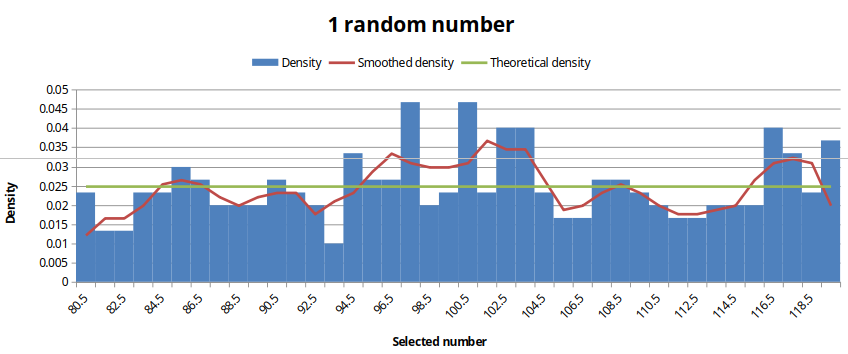
Wouldn’t it make more sense to have most results closer to the base strength calculation? So it would be largely more predictable, but leaves room for random events.
Here’s how it will probably work in the future – generate two random numbers, and choose the closest to the base strength:
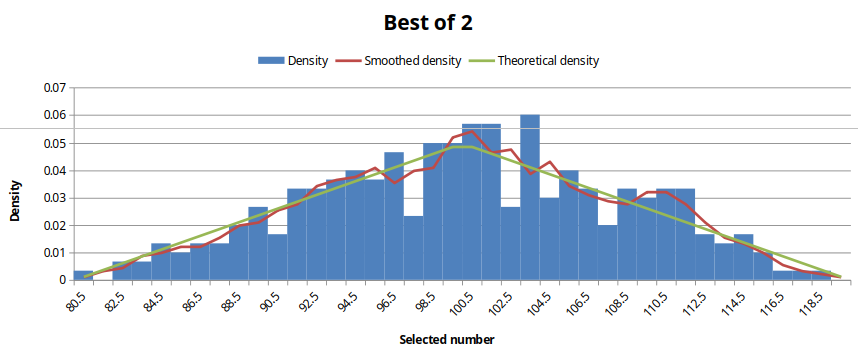
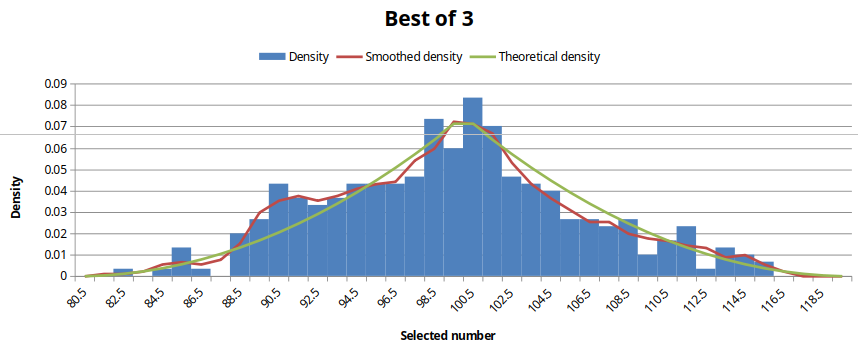
This creates a sort of flat-sided pyramid of results, which I think is more sensible. We could even make it the best of 3, squeezing everything to the centre even more:
Let me know what you think.